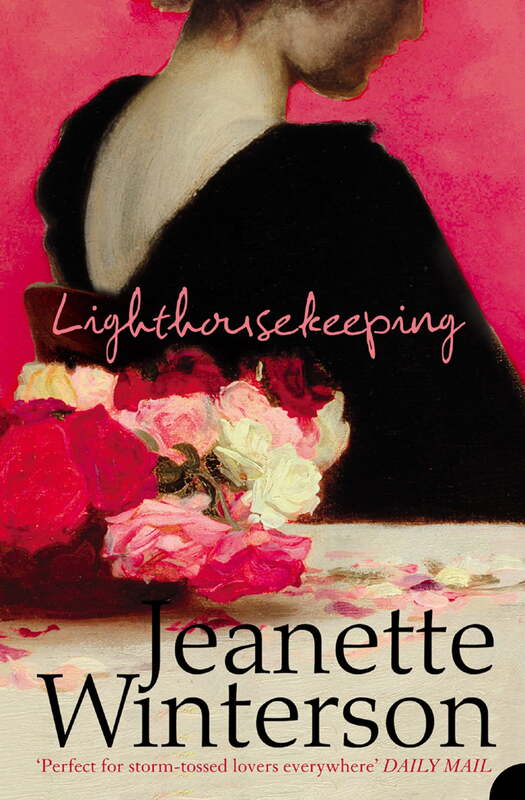
Jeanette Winterson is best known for her debut novel, Oranges Are Not the Only Fruit, published in 1985. Since then she’d had a prolific career, publishing several other novels, a short story collection, a memoir, and a number of children’s books. Lighthousekeeping was her first novel after completing a ‘cycle’, in her own words, that began with Oranges and ended with The Power Book in 2000. It’s a beguiling and unique work, appropriate for beginning again.
The story follows Silver, an orphan who becomes apprenticed to Pew, a blind lighthouse-keeper in the Scottish town where she lives. Pew tells her many stories, among them the story of Babel Dark, a minister who lived there in the nineteenth century. She becomes fascinated by Dark, and as his story unfolds, hers seems to follow alongside it.
The book has a strong setup in the early chapters. We quickly become involved in Silver’s story, carried along by her distinctive voice and strong personality. This carries through to meeting Pew and the intriguing tale of Babel Dark, who presents a mystery: what happened to him? Why did he leave home for two months of the year? The first half of the book explores these questions and Silver’s life with Pew in parallel, and it’s a great start. Winterston’s writing style is wonderful: her use of language is precise and she has a gift for metaphor and imagery. Her passion for storytelling shines through, both in the narrative itself and in the musings from Pew on the purpose of stories.
The second half is less focused. It skips ahead in time to Silver’s adulthood, and other stories meld and blur with the main two: Tristan and Isolde, Dr. Jekyll and Mr. Hyde, Babel Dark’s father, Josiah. None of this is a negative in principle – in fact, it’s par for the course for Jeanette Winterson. Her books often make use of shifting temporality, and intertextual references.
Here, though, it somewhat dilutes what worked in the first half. While Silver’s and Dark’s stories do conclude in a way that’s satisfying, it didn’t feel as strong as the way they began. The book meanders rather than charting a firm course, with interludes of philosophising that work on their own terms but don’t contribute to the larger whole. It leaves the reader with a feeling of incompleteness, like you’ve had part of a good experience but you’re still waiting for the rest.
Lighthousekeeping isn’t Winterson’s best book, then, but I would say it’s still worth a read. The quality of the prose alone makes it worthwhile, along with her insights into time, love, and nature. I also loved the sense of place she created, the remote town by the sea with its seemingly ageless lighthouse-keeper. I appreciated what she was aiming for, even if I didn’t feel she always managed to achieve it. A book that attempts something interesting but falls short is preferable, in my view, to one that is serviceable but lacks ambition and creativity. Jeanette Winterston is short of neither.
Review by Charlie Alcock
The book has a strong setup in the early chapters. We quickly become involved in Silver’s story, carried along by her distinctive voice and strong personality. This carries through to meeting Pew and the intriguing tale of Babel Dark, who presents a mystery: what happened to him? Why did he leave home for two months of the year? The first half of the book explores these questions and Silver’s life with Pew in parallel, and it’s a great start. Winterston’s writing style is wonderful: her use of language is precise and she has a gift for metaphor and imagery. Her passion for storytelling shines through, both in the narrative itself and in the musings from Pew on the purpose of stories.
The second half is less focused. It skips ahead in time to Silver’s adulthood, and other stories meld and blur with the main two: Tristan and Isolde, Dr. Jekyll and Mr. Hyde, Babel Dark’s father, Josiah. None of this is a negative in principle – in fact, it’s par for the course for Jeanette Winterson. Her books often make use of shifting temporality, and intertextual references.
Here, though, it somewhat dilutes what worked in the first half. While Silver’s and Dark’s stories do conclude in a way that’s satisfying, it didn’t feel as strong as the way they began. The book meanders rather than charting a firm course, with interludes of philosophising that work on their own terms but don’t contribute to the larger whole. It leaves the reader with a feeling of incompleteness, like you’ve had part of a good experience but you’re still waiting for the rest.
Lighthousekeeping isn’t Winterson’s best book, then, but I would say it’s still worth a read. The quality of the prose alone makes it worthwhile, along with her insights into time, love, and nature. I also loved the sense of place she created, the remote town by the sea with its seemingly ageless lighthouse-keeper. I appreciated what she was aiming for, even if I didn’t feel she always managed to achieve it. A book that attempts something interesting but falls short is preferable, in my view, to one that is serviceable but lacks ambition and creativity. Jeanette Winterston is short of neither.
Review by Charlie Alcock
 RSS Feed