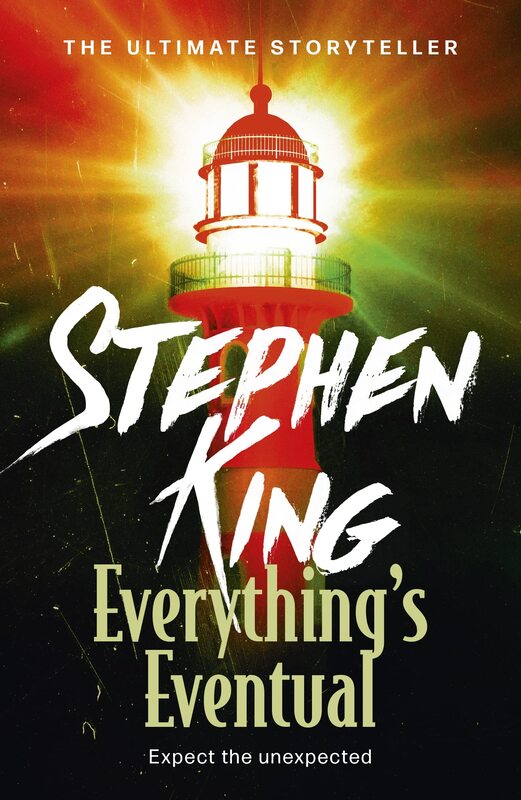
Stephen King has written an awe-inspiring eleven collections of short stories, many of which are best known by their film adaptations – The Shawshank Redemption, 1408, Stand By Me. Everything’s Eventual is the seventh, published in 2002 after the runaway success of his pioneering work ‘Riding the Bullet’ (the world’s first mass-market ebook, which jammed the servers of the host website from so many people trying to download it at once). It includes fourteen short stories and novellas, including ‘Riding the Bullet’, with introductions and/or postscripts from King detailing the inspirations and processes he went through writing them. It’s a remarkably solid collection, with no bad stories and a number of brilliant ones.
- ‘Autopsy Room Four’: This was a tense and tightly-written opener, spoilt only by a punchline of an ending. 3/5
- ‘The Man in the Black Suit’: The tale of a young boy’s encounter with the Devil. The encounter itself is nicely creepy, but I found myself wishing there was more to it. 3.5/5
- ‘All That You Love Will Be Carried Away’: In the introduction, King says that he likes to write down interesting graffiti he finds in a notebook, and used them in this story. It could have felt gimmicky, but fortunately he embeds it in an elegiac story about a man contemplating suicide in a roadside motel. I thought it was wonderful, and in a low-key way it’s one of my favourites. 4/5
- ‘The Death of Jack Hamilton’: I don’t know much about the history of John Dillinger, but this story, written from the point of view of one of his associates, was a powerful, tragic retelling of a real episode from his life. More character-driven than some of the other pieces in this collection, it works because of the mournful tone and the sense of things coming to an end. 4.5/5
- ‘In the Deathroom’: While strongly written and suspenseful, it felt a little derivative and left me somewhat cold. 3.5/5
- ‘The Little Sisters of Eluria’: This novella is set in the Dark Tower universe, and follows Roland of Gilead as he encounters a strange group of nuns who run a hospital in the outskirts of a small town. I enjoyed the return to the world of the Dark Tower, and was impressed by the fact that King managed to make this so gripping even while Roland is immobile for most of the story. 4.5/5
- ‘Everything’s Eventual’: The title story of the collection was also my favourite. King combines an unusual setting with creative use of language, building a voice for the main character that’s strong and memorable. The way the narrative played out was completely unpredictable, and built to a wholly satisfying conclusion. 5/5
- ‘L. T.’s Theory of Pets’: I didn’t quite ‘get’ this one. According to King, it’s the one he often chooses to read aloud when asked to do so, and I could see why, but for me the different elements of the story never quite managed to cohere. 3/5
- ‘The Road Virus Heads North’: This one was a real blast. A writer who finds a strange painting at a car boot sale goes on the run when it comes to life and tries to kill him. It had a blockbuster sensibility that I enjoyed a lot. 4.5/5
- ‘Lunch at the Gotham Café’: I found this one a really weird story, though it doesn’t seem to be on the surface. You get the feeling there’s a lot going on that isn’t said. 4/5
- ‘That Feeling, You Can Only Say What It Is In French’: I have a fondness for this one, because it was the first Stephen King I ever read, after it was handed out in one of my university Creative Writing seminars. I remember reading it and thinking ‘wow, so this is why he’s so popular’. The story itself is a fun exploration of the concept of purgatory. Also, in case you were wondering, it’s déjà vu. 4/5
- ‘1408’: A ‘haunted hotel room’ story that works because of the careful build-up before the main character actually enters the room, and the mystery of what’s actually going on in there. A fine example of how fear comes from the unknown. 4/5
- ‘Riding the Bullet’: King says in the introduction that he feels it’s a shame that the story itself was talked about less than the new format it introduced. I would agree with that, because it’s a very good story. A chance encounter with an undead hitch-hiker becomes a moving reflection on grief and loss. Many stories in the collection have a theme of looking back on a past traumatic event that changed your life, and this is perhaps its clearest elucidation. 4/5
- ‘Luckey Quarter’: A nice little coda to round off the collection. The idea is neat, and King does it justice. 3.5/5
Stephen King’s gift for storytelling shows no sign of diminishing when used for a shorter form. If anything, he benefits from it, because it forces him to be concise. This collection was a brilliant showcase of the breadth of his imagination and his ability to adopt different styles and techniques. I thoroughly enjoyed it.
Review by Charlie Alcock
 RSS Feed